 REGLAZE
The glass
doesn't need
replacing.
Diamond-pad abrasion and cerium oxide chemistry restore scratched, acid-etched, and mineral-stained glass to optical clarity. No demolition. No disruption. No five-figure invoice.
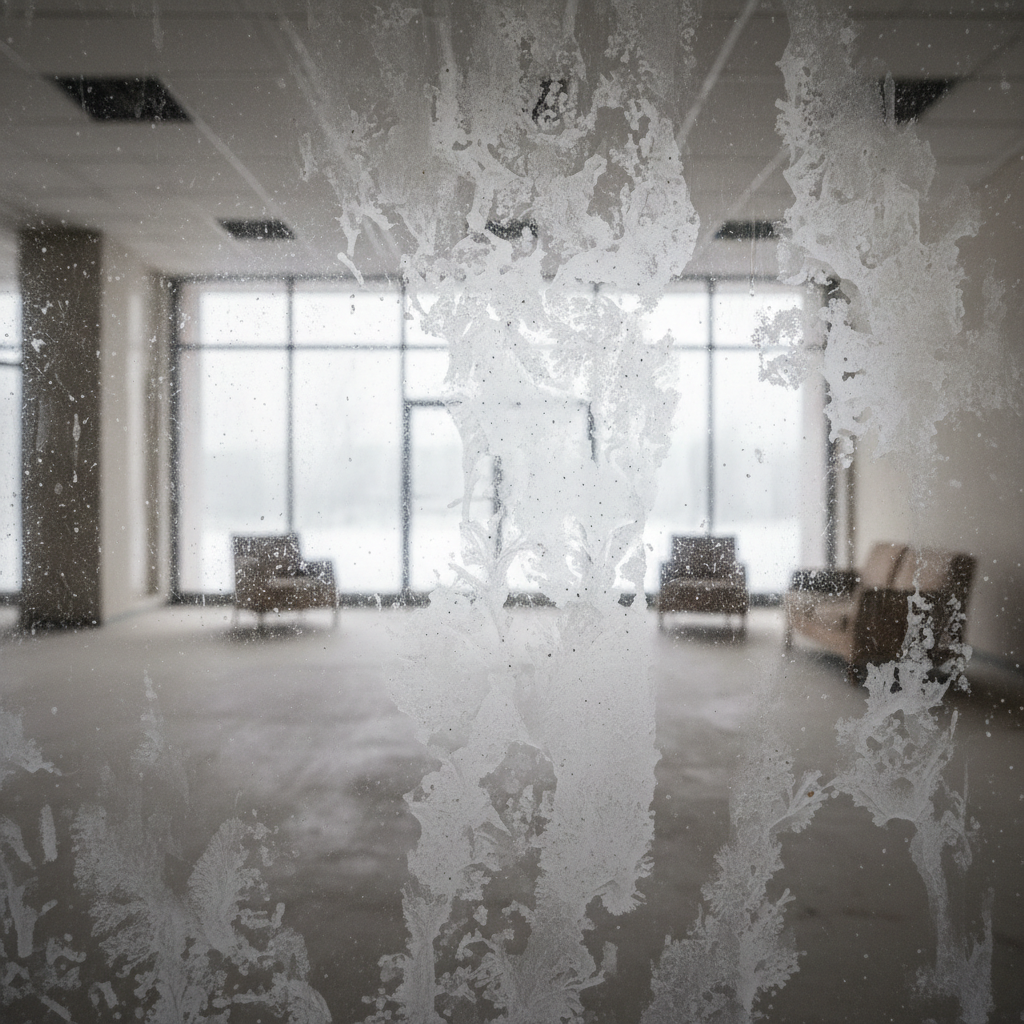
What you're seeing isn't
permanent damage.
Every defect in architectural glass has a measurable depth and a corresponding abrasive response. The science is straightforward — most surface damage exists in the top 0.5 microns. Glass is 4mm thick.
Engineering Note
Standard float glass is 4,000 microns thick. The damage we restore exists in the first 0.5 microns — 0.0125% of total glass depth. Replacement addresses the wrong variable.
Four stages.
One outcome: optical clarity.
Each stage is a precision specification, not an approximation. Grit, RPM, pressure, and pass count are calibrated to glass type and defect classification.
Primary scratch removal. Establishes flat surface plane by abrading to maximum defect depth.
Verify glass thickness ≥ 3mm before Stage 01
Scratch refinement. Removes Stage 01 sub-surface micro-fractures. Surface begins to clarify.
Inspect under raking light between Stage 01 and 02
Haze elimination. Removes abrasive trails from Stage 02. Surface reaches semi-transparency.
Do not skip Stage 02 — Stage 03 will not remove Stage 01 marks
Final optical polish. Cerium oxide chemically bonds with SiO₂ — removes final haze, restores full light transmission.
Maintain slurry viscosity 25–30 cP. Dry polishing causes thermal stress
Next Step
Assessment determines which stages apply to your glass.
Measured results,
not marketing claims.
Light transmission percentage is an objective measurement. Every project is assessed before and after with calibrated photometry. These are real numbers.
Your Glass
Upload photos of the damage. We assess restorability within 24 hours.
Replacement is the
emotional decision.
Restoration is the engineered one. Three clients who almost chose the expensive option.
Our property management firm was staring at a $38,000 replacement bill for the lobby atrium. Reglaze assessed the glass, confirmed it was restorable, and sent a crew for three days. The transmission readings came back at 96%. The glass looks like it was installed last week.
Marcus Okafor
Director of Facilities — Meridian Property Group
Chicago, IL
Six years of mineral runoff from the sprinkler system had turned our floor-to-ceiling windows into frosted privacy glass. I had three contractors tell me replacement was the only option. Reglaze's assessment came back: Stage 02 and 04 protocol. Two days later, I could see the street again.
Priya Chandrasekaran
Owner — Ember & Oak Restaurant
Seattle, WA
The contractor who built our addition left deep scratches across four panes. I was quoted $11,000 to replace them. Reglaze ran their full four-stage protocol. I cannot find the scratches. I have looked. With a flashlight. In raking light. They are gone.
Jeff Kowalski
Homeowner — Private Residence
Austin, TX
Final Assessment
Your glass is most likely restorable.
Find out in 24 hours.
Upload photos of the damage. We identify glass type, measure defect depth from imagery, and confirm restorability — before you commit to anything.